Involved-Field
Radiotherapy for Advanced Hodgkin's Lymphoma
|
| The outcome of treatment for advanced Hodgkin's lymphoma has improved
dramatically over the past two decades. Cure rates of more than 70 percent are now
possible with a hybrid regimen of mechlorethamine, vincristine, procarbazine, prednisone,
doxorubicin, bleomycin, and vinblastine (MOPP-ABV); a regimen of doxorubicin, bleomycin,
vinblastine, and dacarbazine (ABVD); or a regimen of bleomycin, etoposide, doxorubicin,
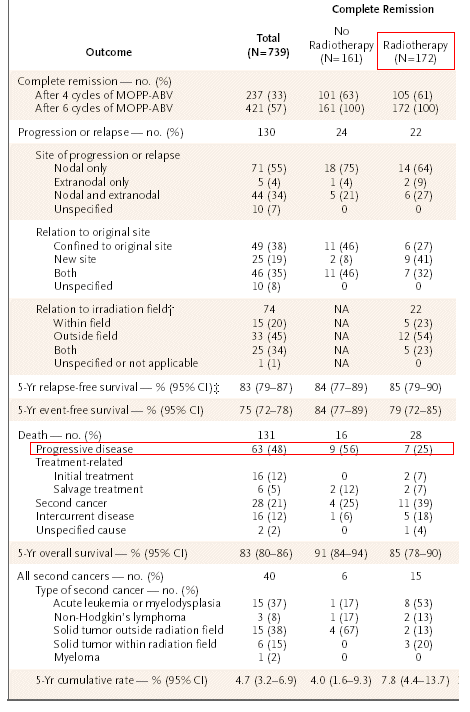
cyclophosphamide, vincristine, procarbazine, and prednisone (BEACOPP). The potential role of radiotherapy after the completion of chemotherapy in patients with advanced Hodgkin's lymphoma stems from the observations that relapses usually occur at initially involved sites and that radiotherapy lowers the rates of recurrence. The results of several randomized studies have, however, raised questions about the benefit of adjuvant radiotherapy. Moreover, a combination of chemotherapy and radiotherapy may increase the risks of late complications, especially second cancers and cardiovascular disease. These risks must be balanced against the risk of treatment failure, since patients who have no response to initial therapy or who have an early relapse are not likely to be cured by salvage treatment. A previous European Organization for Research and Treatment of Cancer Lymphoma Group trial in patients with advanced Hodgkin's lymphoma used a response-adapted strategy consisting of six cycles of chemotherapy instead of eight in patients who had a complete remission after four cycles. The assumption was that two additional cycles of chemotherapy would consolidate an early complete remission, provided that a total of six cycles were given. These considerations led to the present trial to determine whether radiotherapy reduces the relapse rate among patients with stage III or IV Hodgkin's lymphoma who have a complete remission after six to eight cycles of MOPP-ABV hybrid chemotherapy (considered the standard chemotherapy at the time the trial was designed).We randomly assigned patients with previously untreated stage III or IV Hodgkin's lymphoma who were in complete remission after hybrid chemotherapy with mechlorethamine, vincristine, procarbazine, prednisone, doxorubicin, bleomycin, and vinblastine (MOPP-ABV) to receive either no further treatment or involved-field radiotherapy. Radiotherapy consisted of 24 Gy to all initially involved nodal areas and 16 to 24 Gy to all initially involved extranodal sites. Patients in partial remission were treated with 30 Gy to nodal areas and 18 to 24 Gy to extranodal sites. Results Of 739 patients, 421 had a complete remission; 161 of these patients were assigned to no further treatment, and 172 to involved-field radiotherapy. The median follow-up was 79 months. The five-year event-free survival rate was 84 percent in the group that did not receive radiotherapy and 79 percent in the group that received involved-field radiotherapy. The five-year overall survival rates were 91 and 85 percent, respectively (P=0.07). Among the 250 patients in partial remission after chemotherapy, the five-year event-free and overall survival rates were 79 and 87 percent, respectively. A second cancer developed 9 to 112 months after the initiation of treatment in 6 patients in the group that did not receive radiotherapy and in 15 patients in the group that received involved-field radiotherapy; the five-year cumulative rates of second cancers were 4.0 percent and 7.8 percent, respectively.. In the other groups, the five-year cumulative rates of second cancers approached that among patients with a complete remission who were assigned to receive no radiotherapy. Of the 15 cases of acute leukemia or myelodysplasia, which occurred 10 to 99 months after the initiation of treatment, 13 developed in patients who were irradiated (including one patient who received radiation for a relapse). In conclusion, we found that there is no need for involved-field radiotherapy to maintain remission in patients with stage III or IV Hodgkin's lymphoma who are in complete remission after six to eight cycles of MOPP-ABV hybrid chemotherapy. The only patients who benefit from radiotherapy are those in partial remission after chemotherapy. |